
In today’s dynamic job market, a powerful resume goes beyond listing technical abilities. While hard skills demonstrate what you can do, soft skills reveal how you work and who you are as a professional. These invaluable personal attributes and interpersonal abilities are what truly differentiate top candidates.
Put Soft Skills on a Resume
If you want your resume to stand out and capture the attention of recruiters, mastering the art of showcasing your soft skills is absolutely essential.
This in-depth guide will equip you with the strategies and examples you need to effectively integrate soft skills into your resume, helping you land more interviews and ultimately, your dream job.
Why Soft Skills Are Non-Negotiable for Modern Careers
Gone are the days when a stellar technical background alone guaranteed success. Employers are increasingly looking for well-rounded individuals who can not only perform tasks but also collaborate, innovate, and adapt within a team. Here’s why soft skills are more critical than ever:
- Enhance Team Cohesion: Skills like communication and teamwork are the backbone of a productive and harmonious work environment.
- Fuel Problem Solving: Critical thinking, creativity, and adaptability enable individuals and teams to navigate challenges effectively.
- Drive Leadership & Influence: Empathy, delegation, and persuasive communication are vital for inspiring and guiding others.
- Boost Productivity & Efficiency: Strong time management, organization, and initiative lead to better output and streamlined processes.
- Foster Innovation: Open-mindedness and a collaborative spirit encourage new ideas and solutions.
Simply put, soft skills are the human element that powers successful organizations. For more insights into the importance of soft skills in the workplace, check out this article on LinkedIn Learning.
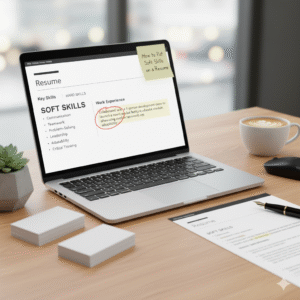
Identifying Your Most Valuable Soft Skills
Before you can strategically place soft skills on your resume, you need to identify which ones you genuinely possess and which are most relevant to the jobs you’re targeting.
Highly Sought-After Soft Skills (Primary Keywords):
- Communication: Verbal, written, active listening, presentation skills.
- Teamwork/Collaboration: Working effectively with others, contributing to group goals.
- Problem-Solving: Identifying issues, analyzing situations, developing solutions.
- Leadership: Guiding, motivating, delegating, inspiring.
- Adaptability: Adjusting to change, learning new processes quickly.
- Critical Thinking: Analyzing information objectively, making reasoned judgments.
- Time Management: Prioritizing tasks, meeting deadlines, organization.
- Creativity: Innovative thinking, generating new ideas.
- Interpersonal Skills: Building rapport, empathy, conflict resolution.
- Work Ethic: Reliability, diligence, dedication.
Supporting Soft Skills (Secondary Keywords):
- Attention to Detail
- Negotiation
- Emotional Intelligence
- Patience
- Flexibility
- Decision-Making
- Stress Management
- Mentorship
- Initiative
- Customer Service
Self-Reflection Exercise: Think about your past experiences – professional roles, academic projects, volunteer work, or even personal achievements. When did you:
- Successfully mediate a disagreement or facilitate a smooth group discussion? (Communication, Conflict Resolution)
- Take charge of a project or guide peers towards a common goal? (Leadership, Teamwork)
- Find an inventive solution to a challenging obstacle? (Problem-Solving, Creativity)
- Efficiently juggle multiple responsibilities and meet all deadlines? (Time Management, Organization)
These real-world examples are your proof points!
Where to Strategically Place Soft Skills on Your Resume
The key to showcasing soft skills effectively isn’t just listing them; it’s demonstrating them with context. Integrate them throughout your resume in these key sections:
- Resume Summary or Objective (Top of Your Resume): This is your elevator pitch. Incorporate 1-2 powerful soft skills that are highly relevant to the role you seek.
- Example (Summary for a Project Manager): “Highly organized and results-oriented Project Manager with 7+ years of experience leading complex software development cycles, leveraging exceptional communication to align cross-functional teams and deliver projects on time and under budget.”
- Work Experience Section (Show, Don’t Just Tell): This is the most crucial section for providing evidence of your soft skills. Instead of simply stating you have a skill, describe how you used it and what the positive outcome was. Use strong action verbs and quantify results whenever possible.
- Instead of: “Good at customer service.”
- Try: “Resolved an average of 40+ complex customer inquiries daily with a 92% satisfaction rate, demonstrating strong problem-solving and empathy skills in a fast-paced environment.”
- Instead of: “Worked well with my team.”
- Try: “Collaborated with a 6-member cross-departmental team to streamline data entry processes, resulting in a 15% reduction in processing time and improved inter-departmental communication.”
- Instead of: “Managed projects.”
- Try: “Led a virtual team of 4 designers and developers, managing project timelines and deliverables to successfully launch a new marketing website 2 weeks ahead of schedule through effective time management and leadership.”
- Skills Section (Categorize Effectively): While primarily for hard skills, you can create a small, distinct “Key Soft Skills” subsection if it fits your industry or the job description explicitly asks for certain soft skills. Keep this concise (3-5 top skills).
- Example: Technical Skills: SQL, Python, Tableau, Salesforce CRM Key Soft Skills: Problem-Solving, Cross-functional Collaboration, Adaptability, Active Listening
- Education and Volunteer Experience: Don’t underestimate these sections! Leadership roles in student organizations, successful group projects, or volunteer initiatives are perfect opportunities to highlight soft skills.
- Example (Education): “Co-led a university research team of 5, coordinating responsibilities and facilitating weekly meetings to complete a grant proposal that secured $10,000 in funding.”
- Example (Volunteer): “Mentored 15 at-risk youth, utilizing strong interpersonal skills and patience to build trust and guide them through educational challenges.”
Tailoring Soft Skills to Each Job Application
The most impactful way to present your soft skills is to customize your resume for every single job application.
- Decipher the Job Description: Scrutinize the job posting for soft skill keywords. Does it mention needing a “proactive communicator,” a “strategic thinker,” or someone with “excellent problem-solving abilities”?
- Mirror the Language: If the job description uses “collaboration,” use “collaborated” in your bullet points. If they seek “strategic thinking,” ensure your examples reflect that.
- Prioritize Relevance: Only include soft skills that are genuinely critical for the specific role. Quality over quantity is key.
Powerful Action Verbs to Showcase Soft Skills
Using dynamic action verbs helps to illustrate your soft skills vividly and makes your accomplishments more impactful.
- For Communication: Articulated, Presented, Negotiated, Mediated, Persuaded, Wrote, Edited, Convinced, Briefed, Liaised
- For Teamwork/Collaboration: Collaborated, Contributed, Supported, Facilitated, Participated, Unified, Partnered, Mentored
- For Leadership: Led, Mentored, Supervised, Delegated, Guided, Coached, Motivated, Chaired, Directed
- For Problem-Solving: Analyzed, Resolved, Diagnosed, Troubleshot, Identified, Overcame, Improved, Streamlined, Simplified
- For Adaptability: Adjusted, Modified, Formulated, Responded, Reorganized, Pivoted, Embraced, Transitioned
- For Organization/Time Management: Managed, Coordinated, Scheduled, Prioritized, Streamlined, Planned, Organized, Executed
Final Checklist for Soft Skills on Your Resume
- Show, Don’t Just Tell: Provide concrete examples and quantifiable results.
- Contextualize Everything: Integrate soft skills within your achievements, not just as a flat list.
- Tailor Rigorously: Customize your resume for every job description.
- Leverage Action Verbs: Make your accomplishments dynamic and demonstrate your impact.
- Proofread Meticulously: Ensure your resume is flawless and easy to read.
By strategically showcasing your soft skills with compelling examples and clear language, you’ll create a resume that not only highlights your qualifications but also paints a persuasive picture of you as a valuable, well-rounded, and indispensable professional. If you need further assistance in crafting a resume that truly reflects your unique abilities, consider using tools and templates available at makemycv.ai. This approach will significantly increase your chances of getting noticed, securing interviews, and ultimately advancing your career.